Abortion pills: Where are they legal and illegal?

In a January 8, 2025, article by the Catholic News Agency titled Abortion pills: Where are they legal and illegal?, author Jonah McKeown writes:

“As states continue to legislate on abortion in the post-Roe v. Wade landscape, a major point of contention as a new presidential administration takes office is the two-drug medication abortion regimen, commonly referred to as the abortion pill.

Abortions done via medication, also called chemical abortions, currently account for about half of the abortions that are done in the United States every year. However, many states restrict the use of abortion pills, specifically the first drug in the two-drug regimen, mifepristone. (Emphasis added)”

Take a look at the map below to see where abortion pills are legal, and where they aren’t:
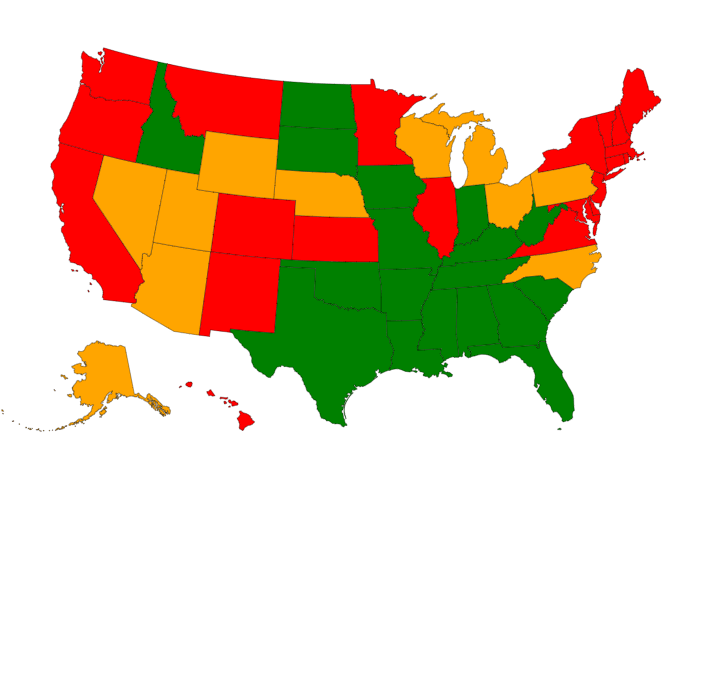
Green is illegal, yellow is limited, and red is legal (go to Abortion pills: Where are they legal and illegal? to click on each state’s specific law)

As the author states:

“At the federal level, mifepristone is approved to abort an unborn child up to 10 weeks’ gestation, having been first approved for such use in 2000. 

The drug kills the child by blocking the hormone progesterone, which cuts off the child’s supply of oxygen and nutrients. A second pill, misoprostol, is taken between 24 to 48 hours after mifepristone to induce contractions and expel the child’s body.

Several states, most of which have some pro-life laws in place, have also passed restrictions on abortion pills designed to protect women, including requirements that only physicians may dispense them. These states include Alaska, Arizona, Florida, Georgia, Iowa, Michigan, Nebraska, Nevada, North Carolina, Ohio, Pennsylvania, South Carolina, and Utah. (Emphasis added)”

and

“A large number of states — most of them concentrated in a contiguous cluster in the South and Midwest — ban abortion in most cases but provide exceptions in cases where the life of the mother is at risk or in cases of rape, incest, or fetal anomaly. In these states, access to abortion pills is likely to be very limited or prohibited entirely. 

States with total bans on abortion pills include Alabama, Arkansas, Idaho, Indiana, Kentucky, Louisiana, Mississippi, Missouri, North Dakota, Oklahoma, South Dakota, Tennessee, and Texas. “

However, as Mr. McKeown. also writes,

” just because these states have bans on abortion pills in place does not mean the drugs are not accessible; women in those states can still receive them in the mail. Under then-President Donald Trump during the COVID-19 pandemic in 2020, the FDA was given the ability to distribute the drug via mail. The administration of President Joe Biden eventually solidified the practice as a norm in 2023. (Emphasis added)

A group of state attorneys general, led by Missouri, is currently suing the Food and Drug Administration (FDA) over its deregulation of the drug, arguing that abortion drugs have been “flooding states like Missouri and Idaho [where abortion is otherwise regulated] and sending women in these states to the emergency room.”

In addition, Texas Attorney General Ken Paxton recently filed a lawsuit against an abortionist in New York, alleging that she illegally provided abortion drugs to a woman in Texas, which killed the unborn child and caused serious health complications for the mother.”

Sadly, as Mr. McKeown writes:

President-elect Trump has committed to keeping abortion pills accessible during his second term — a major disappointment for pro-life advocates, who have urged Trump to use the FDA’s power to enforce a Comstock Act prohibition on the delivery of “obscene” and “vile” products through the mail, which includes the delivery of anything designed to produce an abortion.”

CONCLUSION

As I wrote in my June 16, 2024 blog “The Supreme Court Rejects Challenge by Pro-life Doctors on Abortion Pill“:

“As Life News reported on June 13, 2024:

“The Supreme Court on Thursday rejected a challenge to the abortion pill mifepristone, meaning the abortion drug will be widely available to continue killing babies and injuring doctors nationwide.

The 9-0 decision says the pro-life doctors who brought the case do not have standing – they were not injured, and so the court does not interveneThat’s even though they sued on behalf of women who were injured by the abortion drug by the thousands – including women who have been killed.” (Emphasis added)”

I have a personal interest in this because I had an unwed daughter who became pregnant and started bleeding without telling me because of embarrassment.

She went to a local ER, where the doctors said she was just having a miscarriage and sent her home.

When the pain and bleeding increased, she called me. I took her back to the ER to demand an ultrasound.

As I suspected as a nurse, her pregnancy was ectopic and emergency surgery was performed.

Afterward, the surgeon showed me the picture he had taken (unasked) during the surgery to remove the then-deceased first-trimester baby, my grandchild. The picture was personally so sad to see but I was comforted that the surgeon cared enough to take a picture of this tiny person and show respect.

We need more respect and help for women with an unexpected pregnancy and their babies than a pill without medical safeguards!”

Related

“Safer Than Tylenol” is Deliberate Medical Abortion Disinformation February 26, 2023

Planned Parenthood Sues Kansas to Challenge a New State Law Requiring Abortion Reversal Information to be Provided Before Abortion June 12, 2023

SUPREME COURT RULES THAT STATES MAY DEFUND PLANNED PARENTHOOD

Supreme Court clears way for states to kick Planned Parenthood out of Medicaid – POLITICO

A stunning 6-3 Supreme Court decision on June 26, 2025 has now cleared the way for states to exclude Planned Parenthood from their Medicaid programs, concluding that federal law doesn’t allow health care providers or patients to sue if a state violates a provision of federal law guaranteeing the Medicaid patients can visit their preferred provider.

According to Politico:

“The decision rejected a challenge to South Carolina’s 2018 expulsion of Planned Parenthood from its Medicaid program. It will likely allow other conservative states to similarly expel reproductive and sexual health clinics — shrinking the already narrow network of providers available in the health insurance program for low-income Americans.”

and

“Defunding” Planned Parenthood is a goal of many conservatives, who object to its abortion services. Federal law has long banned federal money from being used for abortions. But Planned Parenthood clinics provide many other health care services that are typically eligible for payment under Medicaid.

Thursday’s ruling will make it easier for states to deprive Planned Parenthood — and other clinics that provide abortions — from receiving Medicaid payments for any of their non-abortion-related care.”

BACKGROUND

As I wrote in my December 14, 2018 blog, “Why is the US Supreme Court Ducking the Issue of States Defunding Planned Parenthood?”:

Most of Planned Parenthood’s federal funding is from Medicaid reimbursements for preventive care, and some is from Title X. At least 60% of Planned Parenthood patients rely on public health programs like Medicaid and Title X for preventive and primary care.” (Emphasis added)

According to a Lozier Institute Report, in its latest report 2016-2017, Planned Parenthood received “$543.7 million in funds from all levels of government in that fiscal year…primarily from the Medicaid program”. (All emphasis added)

CONCLUSION

Ironically, although the brief by Planned Parenthood of Gulf Coast  to the Supreme Court insisted that their clinics “..provide essential medical care to thousands of low-income Louisiana residents through Medicaid” and “offer a range of services, including annual physical exams, screenings for breast cancer and cervical cancer, contraception, pregnancy testing and counseling, and other preventative health services”, the reality is that there are many more places, such as federally qualified community health centers (which do not provide abortions) that provide more comprehensive health care services than those offered by Planned Parenthood.

On a personal note, several years ago my late daughter Marie secretly went to a Planned Parenthood clinic for a possible sexually transmitted disease. She finally admitted this to me when her symptoms grew worse. I immediately took her to my own gynecologist who had to perform surgery to remove part of her cervix to deal with the damage.

Planned Parenthood had missed the diagnosis.

MY “WORST” PATIENT

I was a newly divorced mother of three young children when I returned to nursing to support our little family.

I had been a happily stay-at-home mom for years until my husband had a mental breakdown, took all our money, and fled the state after one of our children died, but I was grateful to find a job on an oncology unit and some childcare.

I was a little nervous about being a working nurse again, but when I started my first day back, I was startled by loud shouting from a patient’s room, even through the door was closed.

I asked what was going on and the other nurses told me that the patient was abusive and shouting all the time, even though he didn’t seem in pain.

The other nurses said they had all agreed to change nurses every day because he was so nasty and they told me I was going to be assigned to him later.

I read the man’s chart and talked to the man’s doctor to ask him what was going on. I was shocked when the doctor said he thought the man was “evil”! I asked the doctor “Like Hannibal Lecter in the movie Silence of the Lambs?” He said yes and I felt a cold chill.

So I made a plan.

When my turn came up to care for the man, I asked to have him all week on the night shift. “No problem!”, the other nurses said.

The first night, the man didn’t sleep and kept shouting loudly. He ignored my questioning so I sat next to his bed and tried to understand what he was shouting.

I discovered that he was enraged and cursing God Himself. I listened quietly until he stopped.

After a while, I held his hand and every time he started to yell again, I replied “God still loves you” over and over until he eventually he fell asleep,

This went on night after night until one night he stopped and slept through the night.

The next day, he woke up and said he wanted to take a walk so I took him to the hallway just as the day shift came in.

The man smiled at them and said “Good morning, ladies!” Everyone was stunned but his whole attitude changed from then on.

Weeks later, I met a student nurse who asked how he was doing. She said she had made a big mistake with his portacath IV access and had to have it replaced surgically. She was devastated but when she apologized, he told her not to worry and that he was fine.

The student told me that she was the nicest patient she ever had!

I told her my story and said that sensitively caring for the most difficult patients can be the greatest reward of all!

Share this:

Reblog

Like

“Suicide Helpline” in Canada Suggested Euthanasia for a Person with Disabilities

In a stunning article on Ales Schadenberg’s May 31, 202 blog titled “Suicide helpline suggested euthanasia for my disabled friend”, Meghan Schrader, a disability justice advocate and scholar, warns that “it is best to nip the USA assisted suicide movement in the bud and not let that movement get its foot in the door” and tells the story of her Canadian friend “Amy”. (Emphasis added)

Ms. Schrader writes that Amy reached out to her for help after Canada legalized euthanasia for disabled people in 2021.

“Amy had endured child abuse, which left Amy with PTSD and physical injuries that caused severe chronic pain. As an indigent disabled person Amy was unable to access thorough medical treatment for these disabilities, so even though Amy wanted to live and was deeply offended by Canada’s decision to expand euthanasia to people with disabilities, Amy’s suffering was so great that Amy thought constantly of dying by “MAiD” (Medical Aid in Dying).”

“However, when Amy called a mental health and suicide crisis support hotline for poor people and asked the operator for help fighting against these thoughts, the operator said, “Well, MAiD is a legit and legal option. Maybe it’s something you should consider. The medical system seems to be failing you. And you are never going to get the opiate pain medication that you think you need.” (Emphasis added)”

“With help from about ten different people, including the Euthanasia Prevention Coalition, Amy was eventually able to take a train four hours away from home and show up in the emergency room of a hospital that opposes “MAiD” and specializes in chronic pain and mental illness. Amy finally received excellent care. Although Amy sometimes still has symptoms of chronic pain and PTSD and life is still often quite a struggle, Amy’s symptoms are manageable and Amy is not planning to die by “MAiD.” It was my honor to attend Amy’s Zoom birthday party recently.

But thanks to Compassion and Choice’s friends in Canada and the systemic ableism that is enabling their cause, the Canadian medical system would have killed Amy before providing adequate medical treatment or support.”

She ends by stating:

“I’ve read statements from proponents of recent assisted suicide bill’s saying that their supporters are “real people with grief and loss, not hypothetical scenarios.” Well, Amy and Rachel are not hypothetical scenarios, they are my friends. I’ve read statements describing myself and other disability rights movement opponents of assisted suicide as “abusive, bullying and cruel.” (Emphasis added)

But I can think of few things more abusive, bullying and cruel than for a suicide prevention hotline operator to tell a caller to go ahead and be killed. I don’t want to live in that world, and like others in the disability justice movement, I won’t be quiet while the proponents lay the scaffolding for that to happen.

I’m sorry if that makes me cruel.”

CONCLUSION

As I wrote in 2015:

“In 2009, I lost my 30 year old daughter Marie to assisted suicide after using an assisted suicide technique after a 16 year battle with addiction.

Marie’s suicide hit our family, her friends, and her therapists like an atom bomb. We had all tried for years to help her, with periods of success. Suicide was always our greatest fear, and we made sure she was armed with crisis helpline numbers and our cell phone numbers at all times. I trust in an all-merciful God Who loves my daughter as much as I do, and I don’t regret one minute of those 16 years of trying to save her.

Both personally and professionally, as a nurse, I’ve cared for many suicidal people whose lives were saved. It’s a myth that suicidal people are destined to commit suicide eventually, and studies have shown that only 10 percent (or less, according to some studies) complete a suicide.1 I’m still determined to save vulnerable people from suicide, regardless of their age, socioeconomic status, or condition. Giving up hope is not an option.

Not surprisingly, since suicide contagion is a recognized risk factor for suicide, one of Marie’s close friends became suicidal on the first anniversary of her suicide but was saved. Is it really just a coincidence that Oregon, which doesn’t include assisted suicide in its suicide statistics, now reports a suicide rate that’s 41 percent above the national average?4

But the “assisted suicide/ euthanasia” machine still rolls on in the US.

The Patients Rights Action organization keeps track of states with bills to legalize assisted suicide and those states that defeated assisted suicide. (see state status updated 5/29/2025)

Please check the status in your state and take the necessary action.

We cannot become like Canada!

FEEDING IS NOT EXTRAORDINARY CARE– DECISION IN THE NANCY CRUZAN CASE ADDS TO THE LIST OF EXPENDABLE PEOPLE

Before the famous Terri Schiavo food and water case gained national attention 20 years ago, Dr. Harvath and I wrote this Op-Ed in the St. Louis Post-Dispatch (no longer online) about the Nancy Cruzan casw, an earlier case of withdrawing food and water from a “so-called “vegetative state”‘ My family was furious when it was pusblished and told me that I was being “mean” to the family.

Unfortunately, such removal has become common and even recently, has resulted in a brother’s death.

Not surprisingly, so-called “assisted suicide” is now allowed in many states and countries

Nancy Valko, RN

Here is our op-ed:
Friday, August 12, 1988
FEEDING IS NOT EXTRAORDINARY CARE– DECISION IN THE NANCY CRUZAN CASE ADDS TO THE LIST OF EXPENDABLE PEOPLE

By Susan Harvath and Nancy Guilfoy Valko                                                                    

Just a few years ago the Missouri Legislature passed a ”living will” law that specifically excluded food and water from the kinds of care that may be withdrawn from a patient. In 1984, the National Conference of Catholic Bishops stated that legislation should ”recognize the presumption that certain basic measures such as nursing care, hydration, nourishment and the like must be maintained out of respect for the human dignity of every patient.”

Therefore, it is hoped that the Missouri Court of Appeals will overturn the recent Circuit Court decision that would deny tube feedings for Nancy Cruzan, a severely disabled woman cared for at the Missouri Rehabilitation Center. The anguish felt by the Cruzan family, which initiated the suit, is understandable. However, directly causing the death of an innocent person – even for reasons of mercy – violates that person’s basic human rights.

The Cruzan case is perceived by many to be an issue of allowing a person to die. Cruzan has been categorized by some experts as being in a ”persistent vegetative state,” an unfortunate and imprecise term at best. However, she is not dying or brain-dead. Rather, she is severely disabled from brain damage and needs no special technology to survive. Withdrawing her feeding tube would not ”allow” her to die – it would ”force” her to die. She would not die from her injuries, but rather from starvation and dehydration.

Also, starvation and dehydration cause a protracted, agonizing death in a fully conscious person. Some experts have stated that Cruzan would feel no pain if her feedings were stopped. Yet Cruzan’s nurses have testified that she has cried, smiled and even laughed in response to stimuli.

The possibility of pain during the length of time before death occurs has led some to propose lethal injections as a more ”humane” way to cause death than starvation. The passive euthanasia of withdrawing feeding logically leads to active euthanasia by injection or other means. Both are unacceptable.

A recent trend has been to classify tube feedings as medical treatment. However, unlike other medical treatments, denial of food from any person (sick or healthy, in or out of coma) will always result in that person’s death.

Ethically, treatments may be withdrawn if they are useless or burdensome to the patient. However, tube feedings are not excessively expensive or burdensome to the patient and do maintain life and prevent the discomfort of hunger and thirst. In deciding what treatment may ethically be withdrawn one must be careful to judge the treatment itself, not the ”quality” of the patient’s life. A person’s limitations do not decrease a person’s humanity or worth.

In the past few years, we have seen many court cases similar to Cruzan’s in other states. Some have involved people less severely disabled than Cruzan. A recent case in North Dakota resulted in a judgment that even feedings by mouth may be stopped. In most cases, it is not the patient who requests that feedings be stopped but rather a third party, usually a family member. Often, as in the Nancy Cruzan case, there is no clear and convincing evidence that the patient would even want the feedings stopped.

Some courts have gone even further and have stated that third parties do not need the approval of a court before a patient’s food and water is withdrawn unless there is disagreement, for example, among family members. This trend has unfortunate implications for all people with mental impairments.

There is a vast difference between not prolonging dying and causing death. In the last two decades, we have seen killing promoted as a humane and compassionate response to unwanted unborn children, newborns with handicaps, and the terminally ill. Let us not add a new category of people (the non-dying, severely disabled) to the list of expendable human lives.

Nancy Guilfoy Valko, R.N., is co-chairperson, and Sue Harvath is program director of the St. Louis Archdiocesan Pro-Life Committee.

“I Thought I Was a Useless Old Woman!”

I decided to become a nurse when I was five and received a Golden book titled “Nurse Nancy”.

I loved the stories about how this little girl helped the other children in the neighborhood by applying bandaids and comfort

I also had two wonderful grandmothers and so becoming a grandma became my other life goal. Since both were widowed and aging, I was able to help.

When I finally achieved my RN, I took my new degree to my father’s mother and she was delighted. “Think of all the people you will help!” I replied “Not as many as you have!’

She was stunned and said ” I am a useless old woman living alone and dependent on family” until I told her how much I admired her dedication to prayer.

Every since I was a little girl, my mother told my brothers and me that we were not to call Grandma between the hours of noon and three. As a devout Catholic, she dedicated those hours to praying for the poor souls in purgatory and for those people who had no one to pray for them. I told her that she helped many more people than I could as a nurse.

She burst into tears and said “I thought I was a useless old woman!”

CONCLUSION

I was honored to love and help care for both my grandmothers as they aged and eventually died. Both were examples to me as they helped whoever they could.

And I learned that being a nurse is more than just caring for the physical needs of a patient. The emotional and spiritual needs of patients-and family-are just as important.

Trump Pardons 23 Pro-Life Activists the Day before the March for Life

In a January 23, 2025 article in the New York Post titled “Trump pardons ‘peaceful’ pro-lifers imprisoned for protesting outside abortion clinics” states:

” President Trump pardoned nearly two dozen pro-life activists Thursday who were convicted under a federal law of illegally trying to block abortion clinic entrances or otherwise keep women from undergoing the procedure.

The pardons, Trump said in the Oval Office, will go to 23 “peaceful protestors” who were prosecuted under the Biden administration. He did not reveal the names of those who will be pardoned. 

“Twenty-three people were prosecuted who should not have been prosecuted. Many of them are elderly people. They should not have been prosecuted,” the president said. “This is a great honor to sign this.”

The Freedom of Access to Clinic Entrances (FACE) Act, enacted in 1994 by former President Bill Clinton, prohibits use of physical force, threat of physical force, or physical obstruction to injure, intimidate or otherwise interfere with “any class of persons [in] obtaining or providing reproductive health services.”

The law also has the same stipulations allowing free access to places of worship — but conservatives say Democratic administrations have been more interested in prosecuting abortion clinic obstruction.”

MY FIRST TIME AT AN ABORTION CLINIC

I was a new nurse when Roe v Wade legalized abortion.

I was shocked and saddened while my other medical colleagues thought this was great.

“What would you do if you found out you were pregnant?”, they asked.
I told them I would have the baby and consider adoption. They thought that was crazy.

I later joined the St. Lous Archdiocese Pro-Life Commitee, the first in the US, and donated items to the Birthright organization that offers “free, confidential resources to any woman regardless of age, race, circumstances, religion, marital status or financial situation.”

In 1987, I was invited to join a group holding signs outside the Planned Parenthood Clinic in St. Louis offering information and help to the women entering. I was nervous walking with my then 2-year-old daughter but there were strict rules about staying on the sidewalk and I was relieved to see the signs with phone numbers and offers to help the women entering the clinic.

But suddenly my 2-year-old daughter dropped my hand and ran to play on the grass in front of the clinic. I panicked, picking her up and running to the sidewalk. I had heard that we could be arrested. Luckily, we weren’t.

CONCLUSION

I am glad President Trump pardoned those peaceful pro-life people but being pro-life is about more than picketing.

Every pro-life person I know is also a person who reaches out to anyone in need.

I know I have been blessed by helping single moms in difficult circumstances, families caring for children with disabilities, people considering suicide, women regretting their abortion, older people facing their impending death, and others.

Being pro-life is not just about ending the horror of legalized abortion but rather about cherishing and caring for all lives!

That is why I am so proud of the National Association of Pro-life Nurses’ button that simply says “I care”.

Great News: Governor Finally Vetoes Delaware Assisted Suicide Bill

In an excellent article in the Christian Post on June 28, 2024, reporter Samantha Kamman reported:

““A national coalition of pro-life nurses (NAPN, the National Association of Pro-life Nurses) says they “will not comply” with Delaware’s assisted suicide bill that passed in the Senate Tuesday as the state’s lone Catholic diocese is calling on people of faith to urge Democratic Gov. John Carney to veto the legislation. “

Ms Kamman explains that:

H.B. 140 passed in the Senate with an 11-10 vote and will become law unless Carney vetoes it. Under the proposed law, adult patients who are “terminally ill” or have received the prognosis that they have six months or less to live can request or self-administer drugs to hasten their deaths.

Both the individual’s attending physician or attending advanced practice registered nurse (APRN) and a consulting physician or APRN must agree on the patient’s condition and decision-making capacity. Two waiting periods must pass before the patient can receive the drugs to end their life, and medical professionals who prescribe the medication must provide the patient the opportunity to rescind the request to kill themselves. 

The law would also grant immunity to medical professionals who offer life-ending drugs to patients, so long as they are “acting in good faith and in accordance with generally accepted health-care standards under this Act.” As the bill states, those “acting with negligence, recklessness, or intentional misconduct do not have criminal or civil immunity.” (All emphasis added)”

Ms. Kamman reported NAPN’s response:

“The National Association of Pro-Life Nurses, which has advocated against assisted suicide legislation for over 30 years, condemned the bill, calling it a “moral catastrophe that corrupts the very soul of healthcare.”

Marie Ashby, NAPN’s executive director, argued in a statement to The Christian Post that the bill “preys” on “the desperate and devalues the disadvantaged,” adding that it offers “poison as a perverse form of mercy” to people society deems “inconvenient.”

“Legitimate healthcare heals; it doesn’t kill,” Ashby added. “This law perverts our profession’s sacred duty, turning nurses from guardians of life into agents of death. We will not be silent. We will not comply.”

NAPN President Dorothy Kane contends, “Delaware has chosen death over dignity, despair over hope.” (All emphasis added)

Conclusion-Great News

On September 20, 2024, Delaware Governor Johns Carey vetoed HB 140, saying that:

“As I have shared consistently, I am simply not comfortable letting this piece of legislation become law. For the reasons set forth above, I am hereby vetoing House Bill 140 with House Amendment 1 by returning it to the House of Representatives without my signature.” (Emphasis added)

“Jessica Rodgers, Coalitions Director for the Patients’ Rights Action Fund told LifeNews she was delighted by the news.

“Thanks to the tireless efforts of Delaware advocates who have shown up year after year after year, assisted suicide will not be coming to their state. I have been amazed and humbled at the work of these doctors, nurses, disability rights advocates, and all who care for their vulnerable neighbors,” she said. “Time and again when the call was put out to take action, they answered. And you answered- you called and emailed Governor Carney’s office and you made the difference.”

And just in time!

“New Study: Brain-injured patients who died after life support ended may have recovered”

Over the years, I’ve written about several of my patients like “Mike”, “Jack”, Katie” and “Chris” in comas or “persistent vegetative states” who regained full or some consciousness with verbal and physical stimulation. I have also recommended Jane Hoyt’s wonderful 1994 pamphlet “A Gentle Approach-Interacting with a Person who is Semi-Conscious  or Presumed in Coma” to help families and others stimulate consciousness. Personally, I have only seen one person who did not improve much from the so-called “vegetative” state during the approximately two years I saw him weekly.

Since then, I have written several blogs on unexpected recoveries from severe brain injuries, most recently the 2018 blog “Medical Experts Now Agree that Severely Brain-injured Patients are Often Misdiagnosed and May Recover” and my 2020 blog “Surprising New Test for Predicting Recovery after Coma.

Now, there is an important new study “New Study: Brain-injured patients who died after life support ended may have recovered”

As the article states:

“Using data gathered over a 7 1/2-year period on 1,392 traumatic brain injury patients in intensive care units at 18 U.S. trauma centers, the researchers designed a mathematical model to calculate the likelihood that life-sustaining treatment would be discontinued. They based their model on demographics, socioeconomic factors and injury characteristics.

Then, they paired patients continuing on life-sustaining treatment to individuals with similar model scores, but for whom life-sustaining treatment was stopped.

Based on follow-up, the estimated six-month outcomes for a significant proportion of the withdrawn group were either death or recovery of at least some independence in daily activities. Of the survivors in the not-withdrawn group, more than 40% recovered at least some independence.” (All emphasis added)”

and

“While many people recover consciousness over a few hours or a day, others remain in the intensive care unit, relying on life support, such as a breathing tube, said Bodien, who also is an assistant professor in the department of physical medicine and rehabilitation at Spaulding Rehabilitation Hospital in Charlestown, Mass.

“Predicting who will recover following severe traumatic brain injury, and to what degree, can be challenging. Yet, families are often asked to make decisions about continuing or withdrawing life support, such as mechanical breathing, within just 72 hours of the injury,” Bodien said.

“This decision is based largely on whether the clinical team believes that recovery is possible,” she added. “It is unknown whether some people who died because life support was discontinued could have survived and recovered had life support been continued.”

Currently, no medical guidelines or precise algorithms determine which patients with severe traumatic brain injury are likely to recover. The most common reason families opt for withdrawing life support measures is physicians relaying information that suggests a poor neurologic prognosis.

And:

“In the study, researchers found that some patients for whom life support was withdrawn may have survived and recovered some independence a few months after injury. Postponing decisions on withdrawing life support may be helpful for some patients, they noted.” (All emphasis added)

ADVOCATING FOR BRAIN-INJURED PATIENTS

I personally know how important and often difficult it is for healthcare professionals like myself as well as families when doctors recommend withdrawing treatments on a comatose patient.

For example and many years ago, I received a phone call from a distraught fellow nurse living in California. Her sister, “Rose”, was comatose from complications of diabetes and had been in an intensive care unit for three days. Now the doctors were telling the family that Rose’s organs were failing and that she had no chance to survive. The doctors recommended that the ventilator and other treatments be stopped so that she could be “allowed to die”. My nurse friend was uncomfortable with the speed of this recommendation even though the rest of the family was ready to go along with the doctors.

As I told her, back when I was a new nurse in the late 1960s, we would sometimes see patients in the intensive care unit who seemed hopeless and we would speak to families about Do Not Resuscitate (DNR) orders. However, the one thing we didn’t do was to quickly recommend withdrawal of treatment. We gave people the gift of time and only recommended withdrawing treatment that clearly was not helping the person. Some patients did indeed eventually die but we were surprised and humbled when an unexpected number of these “hopeless” patients went on to recover, sometimes completely.

About six weeks after the initial phone call, my nurse friend called back to tell me that the family decided not to withdraw treatment as the doctors recommended and that her sister not only defied the doctors’ prediction of certain death but was now back at work. I asked her what the doctors had to say about all this and she said the doctors termed Rose’s case “a miracle”.

“In other words” she noted wryly, “these docs unfortunately didn’t learn a thing.”

CONCLUSION

In 1983, I personally dealt with a withdrawal of treatment situation like this in my own family when my baby daughter with Down Syndrome and a severe heart defect developed pneumonia was placed on a ventilator. She was unresponsive and critically ill.

We hoped to get her stable enough for her planned heart surgery.

One day, a young resident came in and suggested “getting this over with” by removing her ventilator and “letting her die”. I told him that I would sue if he tried.

I went to the chairman of pediatric cardiology whom I knew well and told him what happened and the chairman said he would fire him. Instead, I suggested that he try to educate the young doctor first but, if he didn’t get the point, then he should be fired.

Karen did eventually die in the ICU on the ventilator but I was comforted by the fact that her death was not unnecessarily hastened as well as the fact that later, this wonderful chairman started the first clinic for people with Down Syndrome in the US to deal with their health issues.

This important study should be mandatory reading for all healthcare professionals and families who need to know the facts.

NATIONAL ASSOCIATION OF PRO-LIFE NURSES JOINS ASSOCIATION CHALLENGING CHEMICAL ABORTION IN LANDMARK SUPREME COURT CASE

Washington, D.C.  The National Association of Pro-Life Nurses (NAPN) has proudly joined the Alliance for Hippocratic Medicine, an association of medical organizations suing the United States Food and Drug Administration (FDA) for its reckless removal of essential safeguards for the use of chemical abortion drugs.

The Alliance for Hippocratic Medicine, other medical organizations, and individual doctors argue that the FDA’s actions not only blatantly disregard established protocols for drug safety but also gravely jeopardize women’s health. This case now heads to the Supreme Court asking that the Court hold the FDA accountable for its callous disregard for women’s health and safety.

The lawsuit, brought forth by the Alliance for Hippocratic Medicine and others, highlights the following concerns:

  • Removal of safety standards: The FDA removed safeguards for mifepristone and misoprostol, even though its own label states that nearly 1 in 25 women who consume these drugs will end up going to an emergency room.
  • Increased patient risks: The removal of abortion drug safety standards could lead to a greater number of complications, including hemorrhage, life-threatening infection, and incomplete abortions.
  • Lack of informed consent: Remote prescription practices and the elimination of in-person doctor visits endanger women, particularly those at risk for ectopic pregnancies.

https://nursesforlife.org/press-releases

NAPN President Dorothy Kane issued the following statement on behalf of the organization:

“Nurses are on the front lines witnessing the serious harms to women caused by the FDA’s reckless removal of essential safeguards for the use of chemical abortion drugs. Women deserve the ongoing, in-person care of a medical professional when taking high-risk drugs. The FDA has compromised patient safety and shown a callous disregard for women’s health and safety. This case is about safeguarding women’s health, protecting the integrity of the healthcare profession, and committing to evidence-based care.”

For more information on the legal case, visit Alliance Defending Freedom, the legal organization representing the Alliance for Hippocratic Medicine: https://adflegal.org/case/us-food-and-drug-administration-v-alliance-hippocratic-medicine

                                                               ###

The National Association of Pro-Life Nurses (NAPN) is dedicated to promoting respect for every human life from conception to natural death, and to affirming that the destruction of that life, for whatever reason and by whatever means, does not constitute good nursing practice.