Abortion pills: Where are they legal and illegal?

In a January 8, 2025, article by the Catholic News Agency titled Abortion pills: Where are they legal and illegal?, author Jonah McKeown writes:

“As states continue to legislate on abortion in the post-Roe v. Wade landscape, a major point of contention as a new presidential administration takes office is the two-drug medication abortion regimen, commonly referred to as the abortion pill.

Abortions done via medication, also called chemical abortions, currently account for about half of the abortions that are done in the United States every year. However, many states restrict the use of abortion pills, specifically the first drug in the two-drug regimen, mifepristone. (Emphasis added)”

Take a look at the map below to see where abortion pills are legal, and where they aren’t:
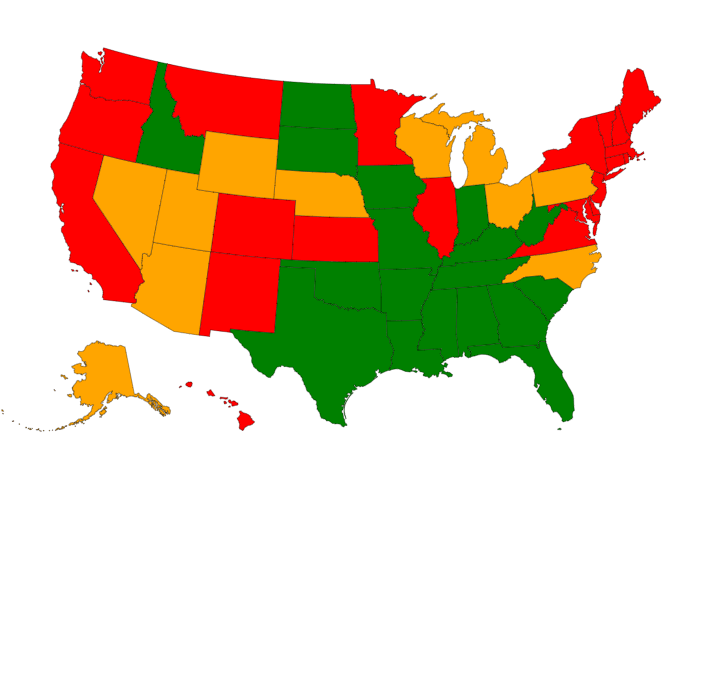
Green is illegal, yellow is limited, and red is legal (go to Abortion pills: Where are they legal and illegal? to click on each state’s specific law)

As the author states:

“At the federal level, mifepristone is approved to abort an unborn child up to 10 weeks’ gestation, having been first approved for such use in 2000. 

The drug kills the child by blocking the hormone progesterone, which cuts off the child’s supply of oxygen and nutrients. A second pill, misoprostol, is taken between 24 to 48 hours after mifepristone to induce contractions and expel the child’s body.

Several states, most of which have some pro-life laws in place, have also passed restrictions on abortion pills designed to protect women, including requirements that only physicians may dispense them. These states include Alaska, Arizona, Florida, Georgia, Iowa, Michigan, Nebraska, Nevada, North Carolina, Ohio, Pennsylvania, South Carolina, and Utah. (Emphasis added)”

and

“A large number of states — most of them concentrated in a contiguous cluster in the South and Midwest — ban abortion in most cases but provide exceptions in cases where the life of the mother is at risk or in cases of rape, incest, or fetal anomaly. In these states, access to abortion pills is likely to be very limited or prohibited entirely. 

States with total bans on abortion pills include Alabama, Arkansas, Idaho, Indiana, Kentucky, Louisiana, Mississippi, Missouri, North Dakota, Oklahoma, South Dakota, Tennessee, and Texas. “

However, as Mr. McKeown. also writes,

” just because these states have bans on abortion pills in place does not mean the drugs are not accessible; women in those states can still receive them in the mail. Under then-President Donald Trump during the COVID-19 pandemic in 2020, the FDA was given the ability to distribute the drug via mail. The administration of President Joe Biden eventually solidified the practice as a norm in 2023. (Emphasis added)

A group of state attorneys general, led by Missouri, is currently suing the Food and Drug Administration (FDA) over its deregulation of the drug, arguing that abortion drugs have been “flooding states like Missouri and Idaho [where abortion is otherwise regulated] and sending women in these states to the emergency room.”

In addition, Texas Attorney General Ken Paxton recently filed a lawsuit against an abortionist in New York, alleging that she illegally provided abortion drugs to a woman in Texas, which killed the unborn child and caused serious health complications for the mother.”

Sadly, as Mr. McKeown writes:

President-elect Trump has committed to keeping abortion pills accessible during his second term — a major disappointment for pro-life advocates, who have urged Trump to use the FDA’s power to enforce a Comstock Act prohibition on the delivery of “obscene” and “vile” products through the mail, which includes the delivery of anything designed to produce an abortion.”

CONCLUSION

As I wrote in my June 16, 2024 blog “The Supreme Court Rejects Challenge by Pro-life Doctors on Abortion Pill“:

“As Life News reported on June 13, 2024:

“The Supreme Court on Thursday rejected a challenge to the abortion pill mifepristone, meaning the abortion drug will be widely available to continue killing babies and injuring doctors nationwide.

The 9-0 decision says the pro-life doctors who brought the case do not have standing – they were not injured, and so the court does not interveneThat’s even though they sued on behalf of women who were injured by the abortion drug by the thousands – including women who have been killed.” (Emphasis added)”

I have a personal interest in this because I had an unwed daughter who became pregnant and started bleeding without telling me because of embarrassment.

She went to a local ER, where the doctors said she was just having a miscarriage and sent her home.

When the pain and bleeding increased, she called me. I took her back to the ER to demand an ultrasound.

As I suspected as a nurse, her pregnancy was ectopic and emergency surgery was performed.

Afterward, the surgeon showed me the picture he had taken (unasked) during the surgery to remove the then-deceased first-trimester baby, my grandchild. The picture was personally so sad to see but I was comforted that the surgeon cared enough to take a picture of this tiny person and show respect.

We need more respect and help for women with an unexpected pregnancy and their babies than a pill without medical safeguards!”

Related

“Safer Than Tylenol” is Deliberate Medical Abortion Disinformation February 26, 2023

Planned Parenthood Sues Kansas to Challenge a New State Law Requiring Abortion Reversal Information to be Provided Before Abortion June 12, 2023

The Supreme Court Rejects Challenge by Pro-life Doctors on Abortion Pill

As Life News reported on June 13, 2024:

“The Supreme Court on Thursday rejected a challenge to the abortion pill mifepristone, meaning the abortion drug will be widely available to continue killing babies and injuring doctors nationwide.

The 9-0 decision says the pro-life doctors who brought the case do not have standing – they were not injured, and so the court does not intervene. That’s even though they sued on behalf of women who were injured by the abortion drug by the thousands – including women who have been killed.” (Emphasis added)

The US Supreme Court decision acknowledged that the Mifeprex pill was approved in 2000 but also that:

“FDA placed additional restrictions on the drug’s use and distribution, for example requiring doctors to prescribe or to supervise prescription of Mifeprex, and requiring patients to have three in-person visits with
the doctor to receive the drug.
” (Emphasis added)

The Cout also acknowledges that the restrictions were relaxed further by the FDA (Federal Drug Administration) when:

“In 2021, the FDA announced that it would no longer enforce the initial in-person visit requirement. Four pro-life medical associations and several individual doctors moved for a preliminary injunction that would require the FDA either to rescind
approval of mifepristone or to rescind the FDA’s 2016 and 2021 regulatory actions. Danco Laboratories, which sponsors Mifeprex, intervened to defend FDA’s actions.”

Now as the Wall Street Journal reports:

Twenty-six states and D.C. allow telehealth for medication abortion. The remaining states have restrictions that supersede federal guidance: 14 ban abortion throughout pregnancy, and the remaining 10 have various combinations of in-person requirements, such as mandatory ultrasounds and visits to doctors and counselors.” (Emphasis added)

WHAT COULD GO WRONG?

As Dr. Christina Francis, an Ob-Gyn doctor herself, wrote in a May 2021 article titled “The government’s abortion pill policy puts mothers’ lives at risk”:

“One of the most significant reasons why an in-person visit has been required is for proper medical oversight as well as a physical exam and ultrasound. These visits are meant to accurately assess the gestational age of a woman’s pregnancy, as well as rule out ectopic pregnancy, which is life-threatening. The difference in size of an 8-week-old and 12-week-old preborn child is significant”

CONCLUSION

I have a personal interest in this because I had an unwed daughter who became pregnant and started bleeding without telling me because of embarrassment.

She went to a local ER where the doctors said she was just having a miscarriage and sent her home.

When the pain and bleeding increased, she called me. I took her back to the ER to demand an ultrasound.

As I suspected as a nurse, her pregnancy was ectopic and emergency surgery was performed.

Afterward, the surgeon showed me the picture he had taken (unasked) during the surgery to remove the then-deceased first-trimester baby, my grandchild. The picture was personally so sad to see but I was comforted that the surgeon cared enough to take a picture of this tiny person and show respect.

We need more respect and help for women with an unexpected pregnancy and their babies than a pill without medical safeguards!

        NATIONAL ASSOCIATION OF PRO-LIFE NURSES JOINS ASSOCIATION CHALLENGING CHEMICAL ABORTION IN LANDMARK SUPREME COURT CASE

        Washington, D.C.  The National Association of Pro-Life Nurses (NAPN) has proudly joined the Alliance for Hippocratic Medicine, an association of medical organizations suing the United States Food and Drug Administration (FDA) for its reckless removal of essential safeguards for the use of chemical abortion drugs.

        The Alliance for Hippocratic Medicine, other medical organizations, and individual doctors argue that the FDA’s actions not only blatantly disregard established protocols for drug safety but also gravely jeopardize women’s health. This case now heads to the Supreme Court asking that the Court hold the FDA accountable for its callous disregard for women’s health and safety.

        The lawsuit, brought forth by the Alliance for Hippocratic Medicine and others, highlights the following concerns:

        • Removal of safety standards: The FDA removed safeguards for mifepristone and misoprostol, even though its own label states that nearly 1 in 25 women who consume these drugs will end up going to an emergency room.
        • Increased patient risks: The removal of abortion drug safety standards could lead to a greater number of complications, including hemorrhage, life-threatening infection, and incomplete abortions.
        • Lack of informed consent: Remote prescription practices and the elimination of in-person doctor visits endanger women, particularly those at risk for ectopic pregnancies.

        https://nursesforlife.org/press-releases

        NAPN President Dorothy Kane issued the following statement on behalf of the organization:

        “Nurses are on the front lines witnessing the serious harms to women caused by the FDA’s reckless removal of essential safeguards for the use of chemical abortion drugs. Women deserve the ongoing, in-person care of a medical professional when taking high-risk drugs. The FDA has compromised patient safety and shown a callous disregard for women’s health and safety. This case is about safeguarding women’s health, protecting the integrity of the healthcare profession, and committing to evidence-based care.”

        For more information on the legal case, visit Alliance Defending Freedom, the legal organization representing the Alliance for Hippocratic Medicine: https://adflegal.org/case/us-food-and-drug-administration-v-alliance-hippocratic-medicine

                                                                       ###

        The National Association of Pro-Life Nurses (NAPN) is dedicated to promoting respect for every human life from conception to natural death, and to affirming that the destruction of that life, for whatever reason and by whatever means, does not constitute good nursing practice.